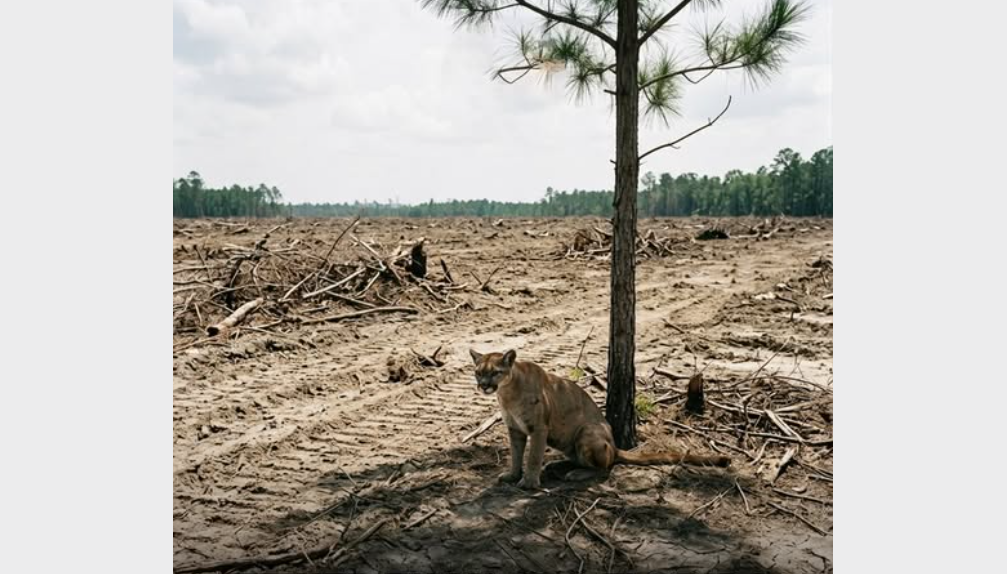
They exist as a single breeding population in south Florida — the only one east of the Mississippi. The species was brought back from near-total [co.lla.pse] in the 1990s through a genetic rescue program that introduced breeding females from Texas. That recovery took decades. What is happening to their habitat is moving faster.
Since the U.S. Fish and Wildlife Service developed its panther recovery plan nearly 20 years ago, Florida panthers have [lo.st] more than 30,000 acres of habitat. Approximately 60,000 acres of Florida habitat are [lo.st] to development every year. Vehicle [strikes] remain the leading cause of panther [mo.rta.lity] — 29 were [k.il.le.d] by cars in 2024 alone.
As habitat shrinks and panthers are pushed into smaller territories, [ag.gre.ssi.on] between individuals has become an increasing secondary [thre.at]: panthers will fight to the death to defend what little space remains.
The pressure is not easing. In April 2026, the Center for Biological Diversity filed a lawsuit challenging federal approval of the Rural Lands West development — a 10,300-acre mixed-use project planned near the Florida Panther National Wildlife Refuge in Collier County.
Five additional large-scale developments and a mine are currently in permitting across Lee and Collier counties — areas that include prime panther habitat. Combined, they would bring more than 80,000 new residents and 260,000 daily vehicle trips through the region.
The agency responsible for enforcing the Endangered Species Act — the U.S. Fish and Wildlife Service — [lo.st] 26 percent of its workforce between January 2025 and January 2026. Conservation groups say the combination of accelerated development approvals and reduced federal oversight has created conditions that a species with fewer than 200 individuals cannot absorb.
Florida’s recovery plan requires three self-sustaining populations of at least 240 panthers each before the species can be considered recovered. There is currently one population. It numbers under 200. It is shrinking.
The math is not complicated. The timeline is.
H/t: Center for Biological Diversity