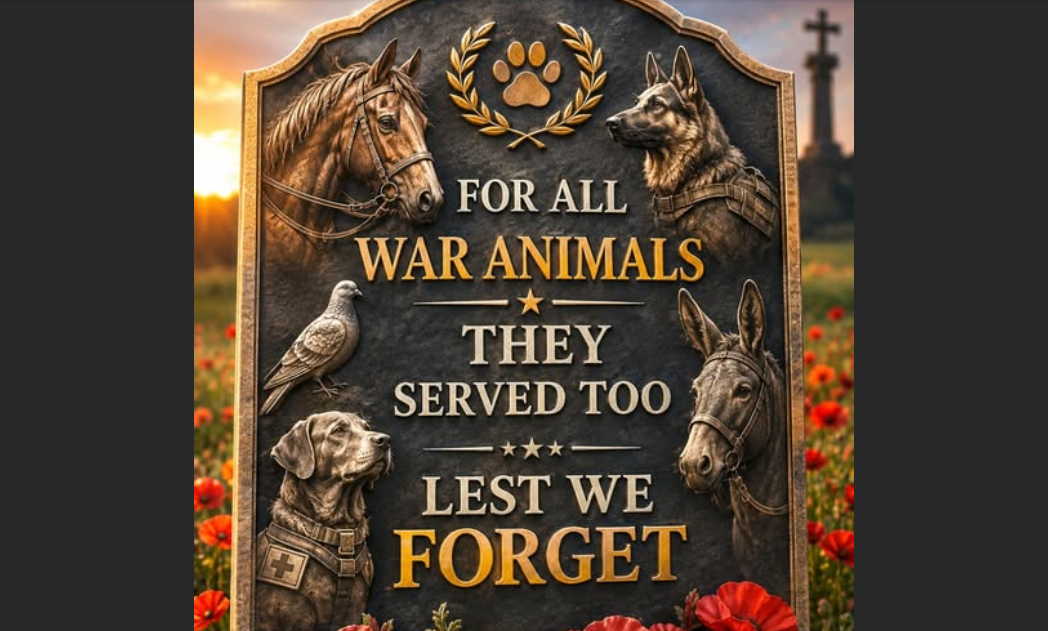
More than 16 million animals are believed to have served during World [W.a.r] I. They carried [am.mun.ition] through muddy trenches, transported [wo.und.ed] soldiers, delivered life-saving messages, and stood alongside military forces amid some of the most [ho.rri.fic ba.ttl.es] in human history. They did not understand the flags they served under, the [en.em.ies] they faced, or the reasons men were [fi.ght.ing]. They only knew the humans who depended on them. And millions paid for that loyalty with their lives.
Dogs became indispensable companions on the [ba.ttlef.ield]. Some raced through gunfire carrying messages between [is.ola.ted mi.lit.ary] positions when communication lines had been [de.stro.yed]. Others guarded military camps, accompanied patrols, pulled supply carts, and searched [ba.ttlef.ields] for [w.o.un.ded] soldiers who might otherwise have been left behind. Horses and mules carried food, [am.muni.tion], medical equipment, and heavy [ar.till.ery] across treacherous landscapes, often enduring [exh.aus.tion], [in.jur.ies], and relentless [sh.ellfi.re]. High above the trenches, carrier pigeons flew through [da.nger.ous] skies with messages that could determine the fate of entire units. Even tiny canaries played a role, [wa.rning] soldiers working underground of [po.ison.ous] gases.
Their service came at an extraordinary cost. According to the Royal Society for the Prevention of [C.ru.elty] to Animals, approximately 2.5 million [in.jur.ed] animals were treated by the British Army Veterinary Corps during World [W.a.r] I, and more than 85 percent were eventually returned to duty. Behind those numbers, however, were countless animals who never recovered, never returned home, and never had their names recorded. Their [suffering] was largely overshadowed by the human stories of [w.a.r], and their extraordinary contribution remained forgotten for generations.
Decades later, a monument was finally erected to give these forgotten soldiers a place in history. On November 24, 2004, the Animals in [W.a.r] Memorial was unveiled near Hyde Park in London. Created by sculptor David Backhouse, the memorial depicts bronze mules carrying heavy loads, a horse, and a dog, alongside carved images of other animals who served in [w.a.rtime]. Its inscription pays tribute to the animals who served and died alongside British and Allied forces.
But among all the words carved into the monument, one short sentence carries perhaps the greatest weight: They had no choice.
Those five words capture an injustice that statistics and historical accounts can never fully express. These animals did not volunteer for [ba.tt.le]. They could not question their orders, refuse [da.nge.rous] assignments, or understand why the world around them was [falling] apart. They were sent into the [cha.os] of [w.a.r] because humans needed them, and they endured whatever came their way.
Their courage has also been formally recognized through the PDSA Dickin Medal, established in 1943 to honor exceptional bravery and devotion by animals serving in [wa.rtime] and other emergencies. Dogs, pigeons, horses, and even a cat have received this prestigious award. Yet for every animal whose story has been remembered, countless others remain anonymous, their [sa.crif.ices bu.ried] beneath the pages of history.
We often remember [w.a.rs] through the names of generals, the bravery of soldiers, and the [ba.ttl.es] that changed nations. But history also belongs to the animals who carried the [wo.und.ed], delivered messages through [en.emy fi.re], and remained faithfully by human sides in places no living creature should have had to endure.
They never chose the [ba.ttl.es] they were sent into. They never understood the [ha.tr.ed] that surrounded them. They simply trusted the people who led them.
And perhaps that is why we owe them more than a memorial. We owe them remembrance, gratitude, and a lasting commitment to treat every animal in our care with the compassion and protection it deserves.
They were [in.noc.ent] lives caught in a human [w.a.r]. They had no choice, but we have a choice to remember them.