Better than humans at looking out for each other.
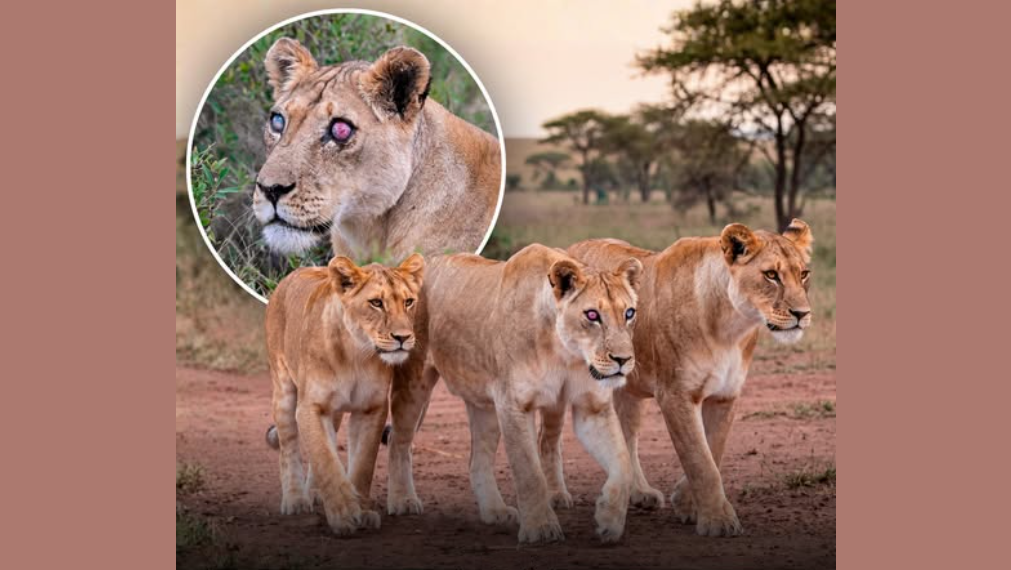
That’s normal behavior for lions…especially females. That’s why it’s called a pride. The female line never changes, it’s only the males that change who form coalitions. The females stay together and related males form coalitions with the goal of [taking] over a pride and siring their own offspring.
In the wild, weakness can mean the difference between life and [de.ath]. For an aging lioness, [lo.sing] her sight should have marked the beginning of the end. But Josie’s story took a different turn—not because she was strong enough to [survive] alone, but because her two daughters refused to let her.
Living in South Africa’s Addo Elephant National Park, Josie began [lo.sing] her vision more than five years before her [de.ath]. Eventually, she became completely bl.ind. For most lions, such a disability would make [hu.nting] nearly impossible and [survival] increasingly uncertain. Without sight, even familiar terrain could become [da.nge.rous], and keeping up with the pride could turn into a daily [stru.ggle].
Yet Josie was never [a.ban.do.ned].
Her daughters, Dawn and Duffy, stayed by her side as their mother’s world slowly faded into darkness. They adjusted to her changing needs, guiding her through unfamiliar terrain, helping her navigate obstacles, and making sure she remained close to the pride. While the wilderness offered little mercy to [vulnerable] animals, these two lionesses gave their mother something extraordinary: a reason to keep going.
When it was time to [hu.nt], Dawn and Duffy took on the responsibility of finding and bringing down prey. But they never treated their mother as someone who no longer belonged. After a successful [hu.nt], they called out to help Josie locate the [k.i.ll] by sound, allowing her to join them and eat. Again and again, they found ways to make sure she was fed, protected, and included.
And Josie was far from helpless.
Despite her bl.indness, she continued to participate in the pride’s activities, relying on her keen hearing and sense of smell to help locate and flush prey from dense vegetation. She adapted to a world she could no longer see, finding ways to contribute alongside her daughters. Her [survival] was not simply a story of being cared for; it was also a testament to her determination to remain part of the life she knew.
Against the odds, Josie lived to the remarkable age of 18—years beyond the typical lifespan of many wild lions. She was eventually [eut.hani.zed] in October 2025 after complications associated with advanced age took their toll. Her bl.indness had not brought her story to an end. With the help of her daughters, she had continued living for years in a world that might otherwise have [left] her behind.
What makes Josie’s story so moving is not just how long she [survived], but what made that [survival] possible.
In the wild, every day demands strength, instinct, and the ability to fend for oneself. Yet Dawn and Duffy showed that survival can sometimes depend on something more than individual strength. They did not simply adapt to their mother’s bl.indness; they changed the way they lived so she could remain beside them.
For five extraordinary years, two daughters helped their mother navigate a world plunged into darkness. They became her guides when she could no longer see, her [hu.nters] when she could no longer [hu.nt] as before, and her companions when the wilderness could have [left] her alone.
Josie’s eyes could no longer show her the world, but her daughters made sure she never had to face it alone.
Because sometimes, the greatest act of strength is not leaving the [vulnerable] behind—but choosing, every single day, to stay. ❤️🦁
And Sometimes nature just answers those questions we are asking ourselves. Here, we learn of motherhood, loyalty, and love. Beautiful 🩵♥️♥️