That cat ja so handsome and cute.🙂
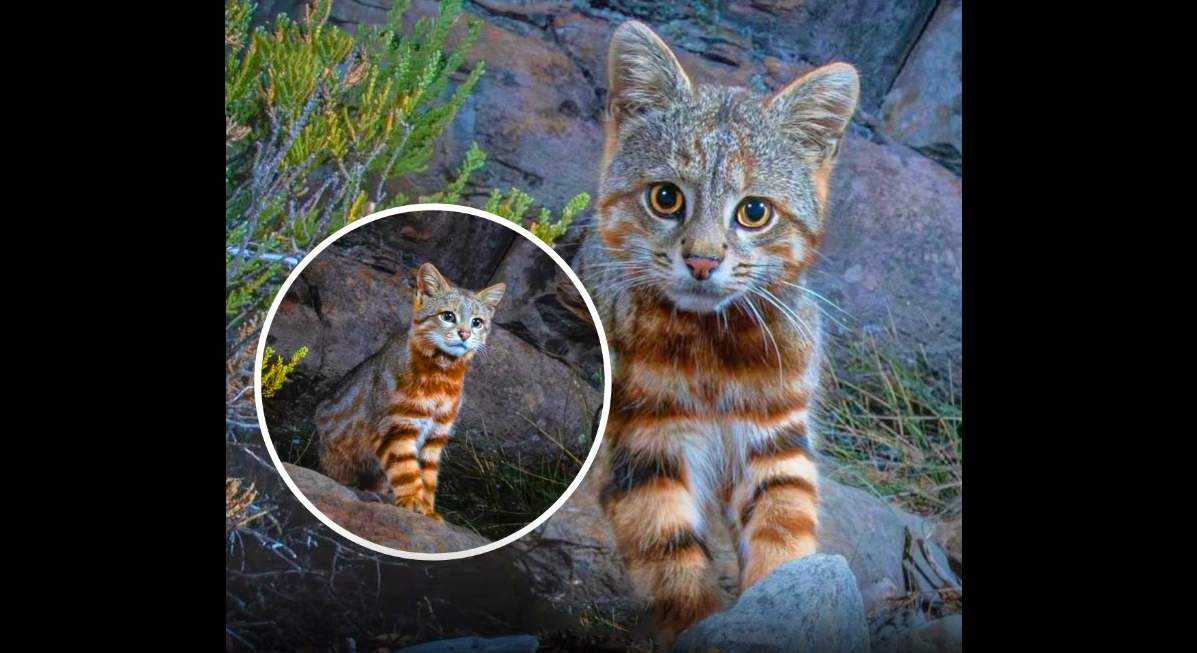
What an interesting example of a newly discovered species… They have different eye colors!
How many of the beautiful cats are in the wild?
A trail camera in Chile recently captured a rare and heartwarming moment: a small wild cat known as the colocolo approached the camera, sniffed it, gently booped it with its nose, and then wandered off.
The colocolo, also called the Pampas cat, is one of the most elusive wild cats in South America. Because it is so rarely seen, scientists still know very little about its daily behavior. Footage from trail cameras like this provides some of the best evidence researchers have to better understand the species.
The colocolo, also called the Pampas cat, is about the size of a large house cat. Its body is around 70 centimeters long, with a tail of about 30 centimeters. It weighs between 3 to 7 kilograms.
But it looks tougher than a house cat. It has long, fluffy fur that makes it appear bigger. And when it feels [th.rea.ten.ed], a strip of hair down its back stands up like a mohawk.
The colocolo is a fashion chameleon. It has six different fur patterns that vary depending on where it lives. Some are gray and striped in the Andes. Others are yellow-brown in grassy plains. Some are rusty and bold in parts of Brazil.
This variation in appearance has confused scientists for decades. For a long time, researchers couldn’t agree on whether the colocolo was one species, three species, or five species. In 2020, a major study proposed splitting the Pampas cat group into five different species. But other scientists still argue it’s one species with several subspecies.
The colocolo is endemic to Chile. That means it’s found nowhere else on Earth.
It lives primarily in Chile’s Mediterranean climate zone in the central part of the country. This is also the most [th.rea.ten.ed] habitat in Chile. Only about 4% of Chile’s protected land is in this region. The rest has been converted to agriculture, vineyards, and human settlements.
The colocolo is Chile’s third-largest wild cat, behind the puma and the Andean mountain cat. But it’s also the most [th.rea.ten.ed].
It’s classified as “near th.rea.te.ned” by the IUCN. It’s not en.da.ng.ered yet, but it’s heading in that direction.
The th.re.ats are mounting. The cat has been heavily exploited for its fur. Poultry farmers [hunt] it because it preys on chickens. Habitat [de.str.uct.ion] continues as land is cleared for farming and development. Road [de.at.hs] are [common]. And domestic dogs pose a [da.ng.er] to the species.
The colocolo keeps a low profile. It’s mostly nocturnal and rarely seen. Trail cameras are one of the most reliable ways to confirm where it lives and when it’s active.
The Colocolo Conservation Project, led by Carlos Castro, is working to save the species. The team uses trail cameras to study the cats, analyzes their scat to understand their diet, and builds predator-proof chicken coops for farmers. When farmers stop losing chickens, they stop [k.i.l.li.ng] the cats.
The project also [va.cci.na.tes and st.eril.izes] domestic dogs and cats in the area, teaches children about wildlife, and uses murals and storybooks to turn the colocolo into a local hero [in.ste.ad] of a villain.
Protecting the colocolo does more than just save one species. Carnivores like the colocolo require large areas and healthy prey populations to survive. By protecting them, an umbrella conservation effect occurs. Thousands of other species of plants, fungi, insects, reptiles, and birds receive protections without a dollar being spent on them specifically.
The colocolo’s [bi.gge.st] enemy right now is being ignored. Most people have never heard of it. And you can’t protect what you don’t know exists.
But every trail camera sighting helps. Every piece of footage adds to the limited knowledge scientists have about this elusive cat. And every bit of awareness brings the colocolo one step closer to survival.
This is incredible 🐱 Such a beautiful and mysterious animal, yet so few people even know it exists… and that’s exactly why stories like this matter. You can’t protect what you’ve never heard of.That little “boop” moment is cute, but it also feels like a reminder,these hidden lives are out there, quietly surviving, just waiting to be seen and protected 🥺🤍