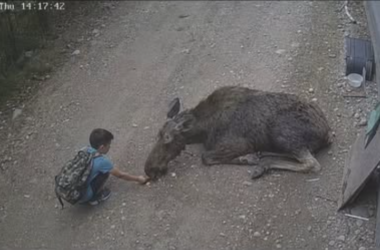
Animals have emotions and feelings. Humans are just slow to recognize.
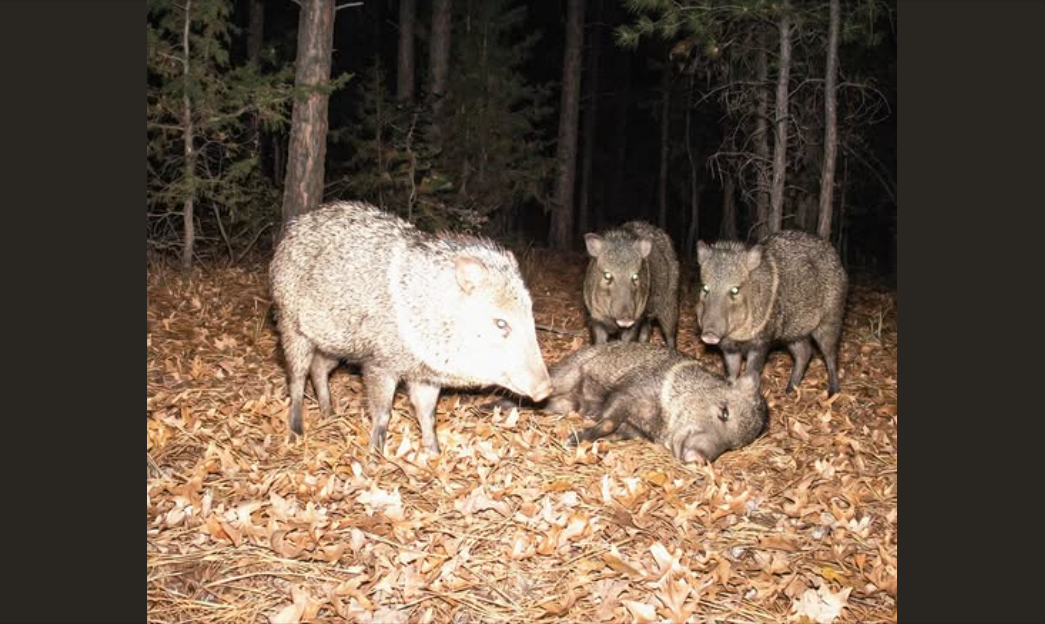
If that is not a display of loyalty, mourning and affection, I don’t know what to say anymore. All creatures have emotions.
Cool to see it documented…
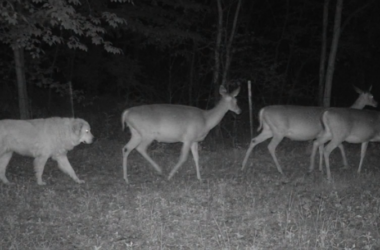
An eight-year-old boy in Prescott, Arizona, set up a trail camera next to a [de.ad] javelina behind his house to film coyotes eating it for his school science fair project. Instead, he filmed the [de.ad] javelina’s herd returning every day for ten days.
They nuzzled the body, slept beside it with their bodies touching, tried to lift it by wedging their snouts beneath it and pushing upward, and chased away the coyotes that came to scavenge it. The boy was furious. I got all mad, he said. I was yelling and saying they were ruining my science fair project because they were chasing away the [pr.eda.tors].
Dante de Kort was eight years old. His grandparents had given him a motion-activated trail camera for his birthday. On January 8, 2017, he found a [de.ad] female collared peccary in the forested area behind his family’s home in Prescott, central Arizona. He set the camera on it. His hypothesis was straightforward: he wanted to document when and how [pr.eda.tors] would consume the [ca.rca.ss]. He expected coyotes. He got a vigil.
The dead peccary’s herd, a group of five, began arriving within hours. Over the next ten days, the camera recorded roughly 100 videos. The herd members came in pairs and alone, at all hours. They sniffed the body extensively. They bit at it. They pressed their snouts against it and stared. They slept beside the carcass with their [bodies] touching the [de.ad] animal’s body. In one sequence, a herd member wedged its snout beneath the [ca.rca.ss] and pushed upward, apparently trying to lift the dead peccary off the ground. The [body] did not move. The peccary kept trying.
When coyotes approached, the herd chased them. In one encounter, two peccaries drove off five coyotes despite being outnumbered. The herd defended a [body] that could not defend itself against [pr.eda.tors] that could have [k.il.le.d] any one of them individually. They held the coyotes off for ten days. On the tenth day, the coyotes overwhelmed the [de.teri.orat.ing] [ca.rca.ss] and consumed what remained.
The herd stopped visiting. There was nothing left to visit.
Dante entered his footage in a regional science fair in February. Mariana Altrichter, a biologist at Prescott College who had studied collared peccaries for years, happened to be attending with her daughter. She saw the videos and recognized what the eight-year-old had captured. She had never witnessed herd members returning to a body repeatedly. Nobody had. It was pretty amazing, she told National Geographic, because it was not just an immediate reaction and then they moved on. It went on for ten days.
Altrichter partnered with Dante and co-authored a peer-reviewed paper published in December 2017 in the journal “Ethology”. The paper’s author affiliations listed Dante’s school, Sacred Heart Catholic School in Prescott, alongside Altrichter’s position at Prescott College and Sara Cortez at the Centro de Ecología Aplicada del Litoral in Argentina. An eight-year-old with a birthday present was co-author on the first scientific documentation of mourning-like behavior in [collared] peccaries.
The paper was careful about the word mourning. The researchers could not prove the peccaries were experiencing [g.ri.ef]. They could prove the herd visited, touched, slept beside, attempted to move, and defended the body of a [de.ad] member for ten consecutive days, and that the frequency of visits declined over time until the [ca.rca.ss] was consumed. Whether the behavior reflects emotional attachment, social bonding that persists beyond [de.ath], confusion about the member’s status, or something science does not yet have a category for is an open question the paper chose not to close.
Collared peccaries live in tight family groups that share territory, sleeping sites, and mutual grooming. They rub scent glands against each other to reinforce group identity. Every member of a herd smells like every other member. A [de.ad] peccary still smells like the herd. Whether that is the reason they kept coming back, because the body still carried the scent of family, or whether it is something beyond scent, the trail camera recorded what it recorded: ten days of a herd that would not leave its dead alone.
Of course they kept returning because she was a family member. All creatures feel [pa.in], love and mourn.
They (all animals) are sentient beings. Why would they not grieve? Although each species acts out in a different way, according to the way the Creator made them, why wouldn’t they mourn?
Animals are more amazing than we can imagine…